
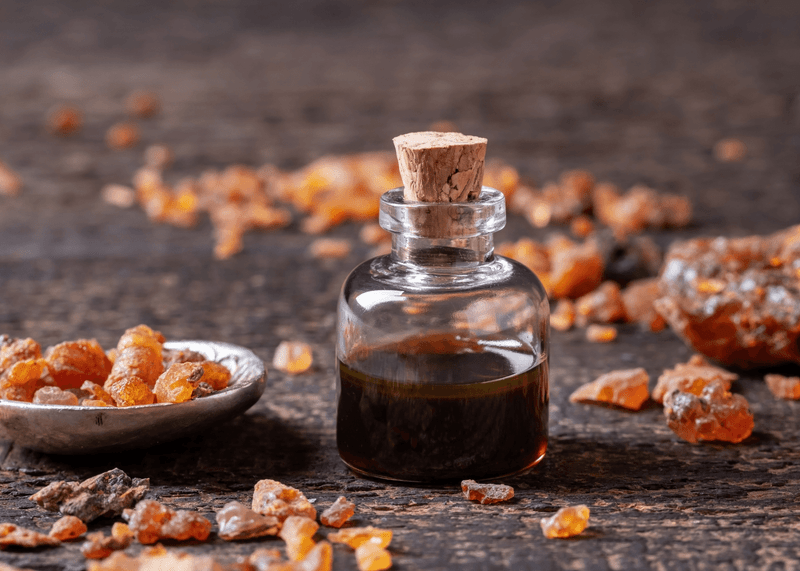
Essential Oil of the Month: Myrrh
Myrrh: (Commiphora myrrha)
“The smell of myrrh lingers mysteriously, a fragranced fog that has drifted through the ages, shrouded (sometimes literally) in deliciously scented superstition.”
from “The Smell of Ancient Magic” The Perfume Society
The Mystery of Myrrh - Ancient and holy, warm, earthy and smoky, Myrrh offers up its sacred scent like incense rising from a timeless temple. Its compelling aroma transports us to hallowed places: the inside of cathedrals, churches, and places of divine communion.
History of Myrrh
For more than 5,000 years, Myrrh has been gathered from the thorny Commiphora trees of Arabia and the Horn of Africa. Once it was so venerated that it traveled the earliest incense routes alongside gold and silk. Under desert suns and starlit skies, caravans carried its fragrance across kingdoms, temples, and tombs.
Throughout history, Myrrh has anointed the living and the dead, sealing the passages of body and spirit. It was burned in places of worship and used in sacred rites to bridge worlds between heaven and earth, between endings and beginnings.

In Egypt, Myrrh was used to honor the dead in mummification processes, burned to honor the gods and anoint kings. It was considered an important ingredient in preserving the body from decay as well as sanctifying ceremonies.
In Hebrew Scriptures, Myrrh anoints the chosen, perfumes the verses of Solomon’s love, and prepares Queen Esther for her moment of grace.
“My hands dripped with myrrh, my fingers with flowing myrrh.” — from the Song of Solomon 5:5 (King James Version)
In Hebrew as well as Greek traditions, it perfumed both prayer and rituals. Later, it would journey with the Magi as a gift for the newborn Christ, a symbol of spirit, suffering, and sanctity.
“When the word for myrrh in Hebrew means ‘bitter,’ and yet the aroma is treasured — the duality of bitterness and beauty, sacrifice and gift, is folded into the scent of myrrh.
— from YU Torah lecture
Bitter yet sweet, earthly yet divine, there is a quiet power in Myrrh. It has long been seen as a living mirror of the human soul, weeping its healing into the world. Myrrh’s origin mirrors this correlation. When the tree is wounded (its bark is cut), it “weeps” sap along the cut which crystallizes into amber ‘tears,” a fragrant sorrow made visible. These fragrant crystals have long been called “tears,” perhaps because of the way they form and fall, or because they arise in response to injury, just as human tears do. These tears, gathered by hand, become the resin that has soothed human hurts for millennia. Because the resin flows only when the tree is cut, the ancients saw Myrrh as a plant that weeps its restoration into the world, a living representation of the human soul. This is why Myrrh is often called “The Oil of the Wounded Healer.”
THE OIL OF THE “WOUNDED HEALER”
The “Wounded Healer,” the archetype described by pioneering Swiss psychologist Carl Jung as the one who heals others through the wisdom of their own wounds, speaks to the paradox that through our own wounds we learn how to help others repair. Inspired by the myth of Chiron, the wise centaur of Greek mythology who, wounded by an incurable venomous arrow, used his deep understanding of pain to heal others through his suffering, turning pain into purpose, and loss into light. This depiction reflects the depth and wisdom that can emerge from suffering, a quality that Myrrh brings from myth to modern mind.
Much like Chiron, Myrrh’s golden resin, born from a wound, seeps slowly into the light, dripping a gift drawn from pain, a balm born of sorrow. Both tree and myth share a gesture of transformation from injury to repair, and from pain, the impulse to mend.


Ancient Egyptians used Myrrh in their holy Kyphi incense, priests burned Myrrh at dawn to greet the sun, and temples across the East offered its smoke to elevate the soul.
Wherever devotion is named in the world’s sacred texts, the smoky scent of Myrrh drifts like incense. Its fragrance carries the echo of distant eras, hallowed places of meditation and sanctuary, silence, smoke and song. Burned with frankincense, it rises like prayer, curling through centuries of quiet communion. It is the fragrance of threshold spaces: between the seen and unseen, the human and the Divine. To inhale it is to remember something ageless within ourselves, the quiet reverence that lives where earth meets heaven.
A Sacred Continuum - Myrrh and Prayer
Over the ages Myrrh has been more than a fragrance, it was a prayer in resin form. When you smell Myrrh, you’re inhaling something nearly unchanged for centuries. Burned in Egyptian temples, traded on desert routes, and used in sacred ceremonies across civilizations, it calls to us from a secret, divine place.
ENERGETIC/SPIRITUAL/EMOTIONAL MYRRH
"The effect of Myrrh oil reaches far into the psyche and can help us transcend and transform.”
Gabriel Mojay - Aromatherapy for Healing the Spirit.
Rooted in the earth yet reaching toward higher realms, Myrrh anchors the spirit while opening the heart to the sacred beyond. Energetically, it moves through the chakra centers from base to crown, steadying the body’s foundation even as it lifts awareness toward light. Its aroma invites stillness, devotion, and remembrance, offering a blessed meeting place where earth and ether, matter and mystery, become one.
Spiritually, it steadies and comforts, guiding us to where wholeness truly begins, reminding us that wellness often emerges through what has been broken. When inhaled, Myrrh draws us inward, toward the still, dark spaces where the spirit may soften and be restored. It whispers of integration, of gathering what was once lost, of finding holiness in imperfection. To work with Myrrh is to remember that within every wound lies the seed of recovery, and within every tear, the fragrance of transformation.
MYRRH IN PERFUMERY
Myrrh is both the foundation and resonance. It deepens, softens, and gives richness to a blend. Like the resin itself, it holds the memory of something profound and sacred, grounding the ephemeral beauty of fragrance in the earth’s enduring warmth. Perfumers use it to round out harsh edges and blend disparate notes into harmony.
As a base note (think in musical terms) and natural fixative, it helps slow the evaporation of more volatile top and middle notes, lending depth, warmth, and longevity. Myrrh offers quiet support that steadies and extends a perfume’s life, allowing the brighter notes to shine more gracefully. Its resinous, smoky, and softly bitter yet sweet scent produces perfumes that linger like memory, rich with peaceful devotion.
Myrrh and frankincense have been paired for thousands of years, their stories so intertwined that they’re almost inseparable in myth and ritual. From a perfumer’s perspective, they’re natural companions, their scents blending seamlessly, each enhancing the other’s warmth, depth and sacred mystery.

Create your own sacred, harmonizing perfume and anointing oil blend:

Pour 10ml jojoba or fractionated coconut oil into a roller ball bottle or small glass bottle. To that add:
- Frankincense essential oil: 3 drops
- Myrrh essential oil: 3 drops
- Sandalwood: 2 drops (brings spiritual awareness, sensual peace and harmony)
- Rose 2 drops (opens the loving heart focus)
- Optional: 2 drops of Bergamot (for a cheerful heart connection)
Press the roller ball into the top and cap. Gently roll the bottle between your hands to warm and blend, then let it rest for 24 hours before use to let the oils harmonize and deepen.
With loving intention, apply to pulse points, heart chakra, third eye or crown chakra areas before meditation or prayer.
As you apply, speak softly:
“As heaven and earth unite within me,
I am grounded in light and lifted in love.”
The above can also be used for a love ritual, self-love, and/or divine connection.
Myrrh endures as more than a scent, a reminder written in resin that what is wounded can still give forth beauty. It is the fragrance of remembrance, devotion, and becoming whole.
PRECAUTIONS: Not to be used during pregnancy.


